• Winter Running Things

    I’ve run in the winter previously, but never trail running.

    As an aside, my trail running was one where I never thought that I had a place to run that I didn’t have to drive a long distance to get there. Well, the late part of my summer and this fall, I discovered that I have about 4 miles of trails at my local city park that I can traverse and run through. Most of the time, I have the entire park to myself because most people are not idiots and they are smarter than to be running in 30-degree weather or the rain or the mud.

    With my discovery this year, I’ve run outside on Saturday mornings pretty much every Saturday and it’s been fun.

    And being a novice runner in the winter, I have found a few things that I think have been beneficial for me.

    It is important to remember that you dress for mile one, not mile none (this was made up by someone that’s not me, but it is catchy). Meaning that when you start, you are probably going to be cold and uncomfortable, but by the time you get going, your body is going to heat up pretty nicely and you won’t want those extra clothes. Uncomfortable is good and normal.

    Head

    If the weather is really cold, somewhere in the neighborhood of 25 degrees, I’d run in a Smartwool stocking cap that I believe is made with some sort of merino wool. It’s 4 or 5 years old, it is reversible, black and gray, and it works great. Not too hot, not too cool. Merinio wool is supposed to be one of those magical materials that breathes, doesn’t stink too terribly, and keeps you warm all at the same time. I do have a few merino wool things that have always performed well.

    The problem with just a stocking cap is that if it is sunny, the sun is incredibly bright and this is my fault because I typically get up and go right when the sun is rising. So I do need a set of sunglasses and have found that a relatively cheap pair of Goodr sunglasses work great. They are light, they stay on my head (your mileage may vary), can be polarized, and are relatively cheap.

    On warmer days, like 35-degrees and expected to warm up, I think I prefer to wear a gaiter that is also a merino wool thing that I got as a Christmas present about 5 years ago that I can pull up over my ears when I start and then pull it down when I warm up. I’ll wear a standard trucker hat without sunglasses and this is actually what I would prefer to wear. It’s better to just be cold for a bit and just tough it out.

    Torso

    This is actually pretty easy. Most mornings I’ll wear some sort of technical shirt, I have 3 or so REI technical shirts that I bought a few years ago that work just fine as an undershirt and then I’ll add a long sleeve shirt, whether it be a Patagonia Capilene Cool shirt, or just another technical long sleeve shirt like this Baleaf shirt. This works in most circumstances in Texas.

    If it is particularly windy, I have a very thin North Face windbreaker that I bought 2 years ago. Not a hoody, just a jacket, and it does work great as well. It’s not necessarily breathable, but it does the job in that it blocks the wind. I know that I could spend a lot more money on something more fancy, something that blocks the wind and is also breathable, but I sort of am fine with just using what I have. Those sort of technical jackets can be upwards of $200 and that seems excessive.

    I did buy this Baleaf quarter-zip running shirt and I absolutely hate it. There’s this huge pocket in the back, like where you would have a tramp-stamp, and so this quarter-zip isn’t at all form fitting, it fits me like a sack and I can’t stand it. Would not buy.

    Legs

    For the first part of the fall, I would just try to run in shorts and hope for the best, but as the weather turned and wind became a bigger issue, I tried to look for pants. You’re going to notice a theme here.

    I bought these Baleaf windpants and I actually really like them. They are very thin, like a windbreaker for your legs with some vents along your thighs. They are very comfortable and I enjoy running in them.

    Then one Saturday the temperature was colder I got brave and wore these Bayleaf running tights. I’m in love with tights from this point forward. These are terrific, they are warm without being too hot, they do a decent job of blocking the wind, they have pockets for my cellphone along my thigh. They’re great. I never thought I’d see the day where I’m putting on tights, but it’s a glorious day.

    I usually leave before my wife is awake and when I got home, she asked me if I was really wearing what I was wearing, and realizing that this was a rhetorical question, I just let her bask in my glory. I am a tights-guy and darn proud of it.

    I’m not sure if I’m supposed to wear something underneath my tights but I do and picked up these Runderwear boxer brief and they are terrific. They are more cotton-like in terms of their fabric rather than a real smooth or slick polyester. There are these little plastic things that are along the legs and they are supposed to keep the briefs from riding up, but I don’t notice them riding up any way. Very much recommend and even wear them running with just shorts.

    Hands and Feet

    I have two pairs of the Darn Tough merino wool element crew lightweight socks and I wear them in the summer and winter. Socks is one of those weird things in that if you have something that works for you then that’s what you should wear.

    I also wear some Smartwool gloves that I bought about 4 or so years ago, just one of those things that I bought and just continue to use. I should probably upgrade to something that is also a bit more rain resistant, but have not done that

    Conclusion

    You’ll note that most of the stuff that I wear is a few years old and/or purchased recently and cheaply. That’s always the best thing about running, which is that it doesn’t have to be expensive and you can typically just wear what you have on hand. If/when this becomes something that you enjoy doing on a regular basis, then you can spend that extra money. For me, I’m perfectly fine trying to find cheap options, although I also fully acknowledge that you get what you pay for when it comes to running gear. When you find the Baleaf pants and tights, you sort of consider those really significant wins because most of the time, cheap items (i.e. the Baleaf quarter-zip) are terrible.

  • Saturday Morning Links

    Photo by Rap Dela Rea on Unsplash

    1. Ever heard of Shirakawa? Me neither. It’s a village in Japan and it is known for being this tranquil village with thatched roof houses and is actually a UNESCO site. But this place has almost become too popular because it is overrun by tourists. Regardless, it is breathtaking in the winter

    Photo by Sam Lee on Unsplash

    2. Do yourself a favor and go Google the “Cueva de los Tayos” and then come back and read this article from Outside Online’s David Kushner. There is no way that I can give you an accurate history of this cave, but it’s nothing sort of amazing. In 1969, this cave in Ecuador was explored and said to contain unimaginable gold and a metallic library and within the tunnels of the cave. The thing is that in order to get to the entrance you have to repel into the cave.

    Tayos is named for the brown-feathered, hook-billed nocturnal birds that dwell inside the cave alongside thousands of bats. The birds act a lot like bats, spending their days in darkness and heading out at night to forage for fruit. They’re called oilbirds ­because of their fatty chicks, which the Shuar capture and reduce to oil. The cave is also rumored to contain artifacts of a lost civilization. A 1972 bestselling book by Swiss author Erich von Däniken, called The Gold of the Gods, claimed that Tayos held carved passageways and a “metal library” of tablets written in an unknown language. Von Däniken has long believed that aliens once inhabited the earth, and the tablets fit his theory that extraterrestrials helped ancient people evolve. The notion has been criticized as pseudoscientific and racist, attributing the achievements of now marginalized earthlings to ­interlopers from space. Yet it spawned a cottage industry of books, conventions, and TV shows, ­including the History Channel’s Ancient Aliens, which premiered in 2010 and is one of the network’s most popular programs.

    A couple of years after The Gold of the Gods was published, the late Scottish explorer Stan Hall assembled a team of 100 scientists, cavers, British and Ecuadorean military personnel, and, remarkably, astronaut Neil Armstrong, who served as a figurehead, and led them into Tayos to unravel the mystery. What they found astonished them. Deep inside, in spots where it would have been impossible to lug machinery, there were stone passageways that appeared to have been cut at right angles and then polished. They also discovered a burial site dating back to 1500 B.C.

    “The cadaver, as if surprised by the sudden intrusion after so many lonely centuries, crumbled to dust when touched,” Hall writes in Tayos Gold, his book about the expedition. Though the team didn’t find the metal library, Armstrong put the adventure “up there with the moon landing.”

    Beyond that, only a small number of intrepid hikers, wide-eyed UFO believers, and even a team of researchers from Brigham Young University—who believed that the metal tablets might be linked to the Mormon faith—have made it inside. The cave has also attracted interest from geologists and archaeologists, who have mapped portions using 3D technology to better understand its scope. (Roughly four miles of the cave have been mapped so far, but an estimated three miles remain.) Toulkaridis calls it “a natural laboratory which is fundamentally untouched.”

    3. I honestly don’t know a ton about hedgehogs, but in England, people are cutting holes in their stone fences to allow hedgehogs to roam from garden to garden. This is legitimately happening.

    4. Via Smithsonian Magazine, Italy is going to recreate the floors in the Colosseum. I think I know about this because of the movie Gladiator, but there was the floor of the Colosseum and then during the games, they could bring in wild animals into the fight:

    The structure consisted of staging areas, ramps, pulleys, ropes and other mechanisms that allowed workers to create a seamless show aboveground. Engineers even devised an underground elevator of sorts that lifted lions, bears, leopards and other caged wild animals into the arena.

    “The hypogeum allowed the organizers of the games to create surprises and build suspense,” Heinz-Jürgen Beste, a researcher at the German Archaeological Institute in Rome, told Smithsonian in 2011. “A hunter in the arena wouldn’t know where the next lion would appear, or whether two or three lions might emerge instead of just one.”

    5. Understanding the idea of the size of the universe and the size of our rock orbiting the sun is always an amazing dive into relativity.

  • Saturday Morning Links

    Photo by v2osk on Unsplash

    1. Whenever I find a new place, the first thing that I think about is what it would be like to go for a run there (or even just a walk) and that thought is no different when I look at photos of Snowdonia, which is a Welsh national park with 827 square miles. FieldMag has some additional photos and tips if you would ever travel there (when that can happen).

    Photo by Leo Sammarco on Unsplash

    2. I had never thought about a tree of the year, but this is a video of Scotland’s tree of the year and it honestly reminds me of the treeless landscape of Snowdonia and the idea that the the landscape of Scotland had all of their trees forested, which is terrible, and so bringing back the trees is such a great thing.

    3. I’ve linked to the videos from Beau Miles previously, but these are fantastic. It’s not that the videos are action packed, but they are contemplative and that’s such a good thing nowadays. In any event, Miles builds a junk cabin, a cabin built from the junk wood he has laying around. I think he’s a carpenter by trade, or his father was. I go back to building the fort for the boys when lockdowns first started and Miles and I started those projects at the same time, his was significantly more ambitious than mine.

    4. It is becoming an audio and visual Saturday Morning Links and the great Danny MacAskill is always a good time. I wouldn’t scoot down on my ass on some of the things he’s riding a bike down. Amazing to have that much control.

    5. You ready for something new? I’m going to take a Penn U course of being resilient in uncertain times. You are probably thinking that you already are resilient, hell, you’re still here, but the idea would be that you and I don’t know everything and you might learn something news. I am excited about this class and will report back.

  • Saturday Morning Links

    Photo by Paolo Bendandi on Unsplash

    1. We’ll get to this in a second, but Catch-22 was set on a small island in Italy called Pianosa. Finding photos of that island is very difficult, but finding photos of Elba Island, which is just east of Pianosa, looks pretty well amazing.

    Photo by Chris Barbalis on Unsplash

    2. Earlier this week it was Martin Luther King, Jr. Day. The boys had Monday off so I asked them on Tuesday what they knew about MLK, or what they learned in school. They had talked about how they were making posters about MLK in art. They both said that MLK made a speech, something about “I have a dream.” So then I stared to tell them about MLK, but then realized that I sort of needed to explain the Civil War first to explain why he was making those speeches. There was a lot of context that I had to add there to make it all make sense, for example, that slaves were freed, but black people were not treated like white people and that MLK really helped change the law and that was the significance of the speeches and protests. I also think that explaining things incredibly simplistically, almost like a drunk history lesson, usually works best and it is memorable for them as they did remember why MLK was important the next day (I am not drunk or even drinking when I do this).

    3. I finished Hulu’s Catch-22 mini-series and if you were looking for a place to escape reality, look at some beautiful cinematography, and enjoy a good story, yes, all of those things will happen, but you will also suffocated by the fact that life is full of sadness, despair, and utter depression, then this is the perfect series for you. Truthfully, this is wonderfully acted, beautifully shot, and if you loved Band of Brothers, then this will be absolutely perfect for you. I highly recommend, but you’ll be on quite a ride.

    4. Last week, we brought you a white moose and now, via National Geographic a white cougar was caught in Brazil. Absolutely amazing.

    5. This is one of those things that I thought was not true, but it is, via Open Culture, a 5,000 year old artist’s palette from Egypt.

  • Saturday Morning Links

    Photo by Stéphane Juban on Unsplash

    1. Ever heard of Seychelles? Me neither. It’s an actual country in Africa. I thought I had heard of them all, but I was wrong about that. The Seychelles islands or the Republic of Seychelles is an archipelago of 115 islands on the east coast of Africa.

    Photo by Ron Barabash on Unsplash

    2. It’s a white moose. Not a euphemism. My Modern Net has photos of an absolutely spectacular white moose that’s roaming the forests in Sweden along the Norway border. Just something I’ve never seen.

    3. Sticking with the animal theme, via Scientific American, the dire wolves are not really close to current wolves at all:

    After sequencing five genomes from dire wolf fossils between 50,000 and 13,000 years old, the researchers found that the animals belonged to a much older lineage of dogs. Dire wolves, it now appeared, had evolved in the Americas and had no close kinship with the gray wolves from Eurasia; the last time gray wolves and dire wolves shared a common ancestor was about 5.7 million years ago. The strong resemblance between the two, the researchers say, is a case of convergent evolution, whereby different species develop similar adaptations—or even appearances—thanks to a similar way of life. Sometimes such convergence is only rough, such as both birds and bats evolving wings despite their differing anatomy. In the case of dire and gray wolves, lives of chasing large herbivores to catch some meat on the hoof resulted in two different canid lineages independently producing wolflike forms.

    4. Zach Miller is all sorts of amazing. An ultrarunner that runs as hard as anyone I’ve ever seen. I honestly do not know what it means to run that hard. I’d be honest and tell you that I would be afraid to run that hard for fear of wearing out.

    To manage the good times, but also the good times, that’s what makes a 100 mile race a 100 mile race . . . A lot of us have a perception of what limits are. When I race, I guess I throw them out the window. It’s not that I don’t have limits, it’s just maybe I’ve perceived them differently. I just don’t know where they are. I think that’s one of the most beautiful things about racing. So many times I think we step to a raceline with this idea of what we are capable of doing, but sometimes I think we’re capable of a lot more than what we think. If you can step to a raceline or a circumstance in life and say I’m not afraid of the failure, and just go for it. I may not succeed, but I’m willing to try, that’s a really freeing and fun thing.

    5. I don’t know that I realized it, but I think last week was my 52nd week of Saturday Morning Links. I don’t think I missed a week, but I could be wrong. If I have missed a week, it might be just one or two. Regardless, this blog or site or whatever has been what I really wanted it to be, which is a place for me to write that didn’t fit in what I was writing other places. It was also a place that was not Twitter and I think that’s a good thing. I said before that I hope that I’m a bit more consistent here than other places. That might not happen the next couple of weeks because work continues to be a beast. But those things pass (I hope).

  • My Year Running 2020

    This isn’t going to be a particularly long post. I’ve already written about the shoes I ran in this year and what I know about running shoes.

    But I did want to detail what I did run in 2020.

    For comparison purposes, I ran 1,065.6 miles in 2019. In 2020, I increased that mileage by nearly 500 miles, although that wasn’t intentional. I was just sort of running. In 2020, I ran 1,523.6 miles. I should also mention that it is likely that the miles run in the shoes isn’t going to match up with the miles run because I sometimes forget to associate a run with a shoe. I do it manually rather than let it be automatic.

    My worst running month was March, which is when the pandemic hit. I don’t know why I didn’t run as much that month. I also know that I was building a new fort for the kids and my weekends were pretty well taken doing that. I certainly didn’t go anywhere.

    My best months were basically May and October and that’s probably because from a weather perspective, these are typically great months to run, especially outside.

    I averaged 127 miles a month, which is a shade over 4 miles a day or so, depending on the month. In comparison to 2019, I ran 88.8 miles a month and that works out to about 3 miles a day. I think a large part of the running increase is that at some point in 2020 I started to run on Fridays, which I had previously not done. Previously I had only run on Mondays, Wednesdays, and Saturdays. On Fridays, I’ve been running at least 5 miles in the morning, which is a mile shorter than my typical 6 miles on Monday and Wednesday.

    Month Miles Run
    January 119.0
    February 130.5
    March 108.6
    April 125.2
    May 139.2
    June 123.7
    July 119.3
    August 148.3
    September 118.9
    October 139.5
    November 124.7
    December 126.7
    Total 1523.6

    This is how I spent my days running in my various shoes for 2020:

    From the linked post above, I absolutely adored the 1080v10 from New Balance and the Kinvara 11’s are my current jam. I can’t get enough of them and really love running in them. They’ve been a superb shoe for me, although I’ve seen early reviews of the Kinvara 12’s and am a bit concerned.

    You’ll also note that I didn’t talk about the Terra Kiger 5 or the Saucony Pergrine 10. I had good luck with the Kiger for the most part, but then, while on vacation in Arkansas this fall, I started to develop a hot-spot on the outside of my left foot. I thought it was maybe the socks, so I changed them, and the hot-spot persisted. Considering how much luck I had with the Kinvara I decided to try the Peregrine, which is also a 4mm drop shoe and have been really happy with it. It’s a good shoe, perhaps a bit heavy, but it is an enjoyable ride. That’s always sort of the curse of finding something that you like, is that it pretty well fits like a glove and I don’t want to vary from it.

    I didn’t achieve anything by running in 2020. No races or anything fun like that. I do want to do a race in the spring of 2020 for my birthday and my lovely wife has approved this. That’s next on the agenda. I’ve also been doing more vertical gains, which is ridiculously difficult, and this basically means running on an incline for miles at a time. I have no idea why I’m doing this, but it absolutely kicks my tail.

    One thing that did happen is that I did finally get into the “Superior” portion of VO2 Max for my age and gender, which is pretty cool. I’ve never been athletic at anything in my life, so this is certainly something to be proud of for me, as someone that spends a ton of time running.

    Here’s to an ultramarathon in the spring of 2020 and hopefully a few more miles along the way.

  • Saturday Morning Links

    Photo by Simon Rae on Unsplash

    1. That’s Fassa Valley, Italy, and doesn’t seem real. The mountains are the Dolomites, which are some amazing mountains up that way. The valley is formed by the Avisio River. This is also in the Trentino region of Italy, which is sort of like a state. There’s also this incredible castle, called Buonconsiglio Castle which is pretty incredibly in its own right.

    Photo by Simon Rae on Unsplash

    2. One of the dumbest, but best things I ever did was in law school and going to Ireland for a summer session. Incredibly privileged, but it did allow me to see part of the world that I would have never seen before. In part of that trip, was a two-week stay in Belgium, which was awesome and the weekend in-between, some friends and I went to Amsterdam. The friends went to Amsterdam to do things that you can only do in Amsterdam and I’ve never done those things, up until this day. Not judging, just stating. One of the best things I did while there is to go to the Van Gogh Museum and also the Rijksmuseum. It was announced that the Rijksmuseum had digitized 709,000 works of art. I could not recommend those museums more if and when you are able to do so.

    3. This is so great. I learned more about the ancient history of Rome in 13 minutes than I have in years. Thanks Open Culture.

    4. Outside Online’s Jen Murphy on Underwater Torpedo League:

    The brainchild of Prime Hall and Don Tran, two former Marine Raiders (an elite unit of the U.S. Marine Corps), underwater torpedo is played in the deep end of a large pool—ideally 13 to 14 feet deep—by two teams of five. The aim is to get a ten-ounce, ten-inch-long torpedo-shaped toy into a kid’s hockey net anchored at the bottom of the pool by dive bricks. Players may move the torpedo by swimming with it, handing it off, or passing it to another team member, all while submerged. They can surface to take a breath, but not if they are holding the torpedo—that results in a penalty. Tackling, pulling, holding back, and grappling are only allowed on the player in possession of the torpedo. Kicking, punching, choking, and single-limb submissions are forbidden. “We had to add that last foul, because we got a lot of MMA fighters who were putting players into weird ankle locks,” explains Tran, 31. Each game has a referee, and despite the underwater roughhousing, Hall, 35, says there have only been minor injuries, thanks in part to the fact that fins are also forbidden, so players move with less momentum. “That means less impact when players collide,” he says. A typical match, says Tran, lasts until a team scores five goals, or about ten minutes, with 30 seconds between each match to regroup. Games are played in a best-of-three-matches format.

    5. Need some of the good stuff? NPR with the best photos from the Siena international Photo Awards.

  • My Year in Charts 2020

    This idea of creating a post about my life in charts really didn’t culminate unit l recently, but since about December 27, 2019, I started tracking me doing push ups. I had a conversation with my brother-in-law about a guy that did 100 push ups for a year. I thought I could do the same thing. That meant that I couldn’t miss a day and I was lucky enough to be able to do that. What started as just tracking push ups ended up tracking a handful of things through the year. And since I had all of this information, I could create some charts that displayed what I did through the course of the year.

    As an aside, I utilize Loop Habit Tracker to track my habits. And really, these are all things that I wanted to be habits. I thought (and I think it proved to be true) that if I consistently did these things, that my life would be better.  As for the Loop Habit Tracker, it is dead simple, you can add a reminder about if you’ve accomplished the task for the day and the only thing it allows you to do is to check if you did the habit. That’s it.  It has zero bells and whistles and it has zero advertisements. It will also do a nice job of displaying the consistency of your habit and also provide the various streaks that you are able to go on through the course of using the app. If you want it to do more than to just check things off (i.e. you want something to keep track of notes or different things), then this is not the app for you. This app will let you know your current streak as well as your current score, which is probably some sort of success rate

    These are also things that made my life better and for the most part, these things are free. The books cost money, but that’s it.

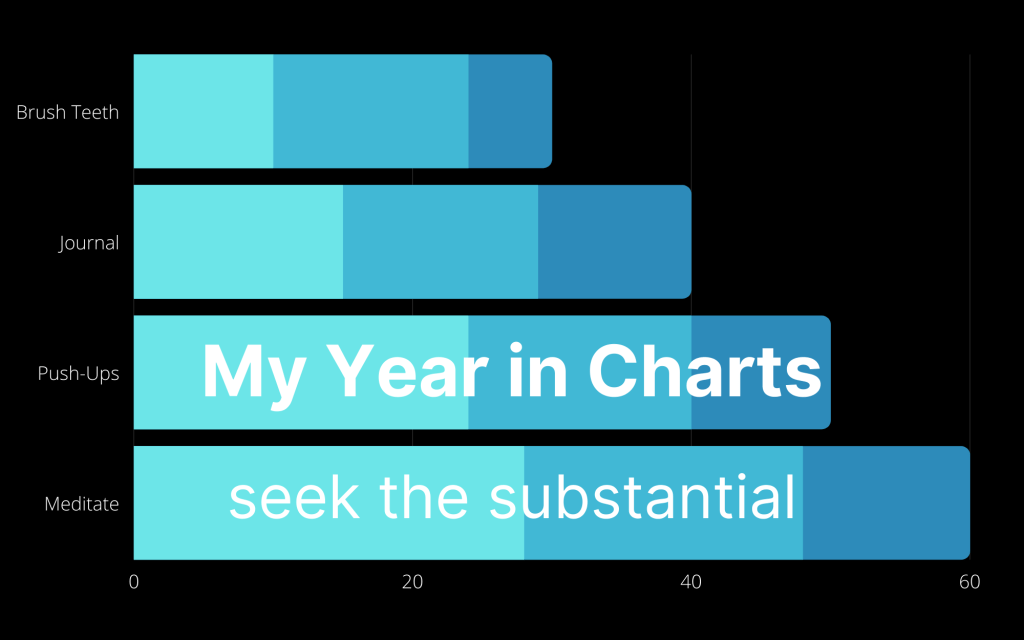
    Here are the habits I tracked this year in comparison to the number of days where I started tracking the habit. As an example, I didn’t start journaling until April or so, thus the available days is less than 366 (2020 was a Leap Year). Also, the “Current Score” is from the app and I don’t know how that is figured. I’ve done push-ups for more than a year straight and only have a score of 95%. I suppose the streak is what’s important now.

    Habit Days Complete Available Days
    100 Push Ups 366 366
    Meditate 259 366
    Read a Book 355 366
    Journal 263 265
    Brush Teeth 354 366
    Drink a Glass of Water 93 93

    Brush Teeth: I actually think I started using the habit tracker because I was doing a terrible job of brushing my teeth at night. I would just get tired and go to sleep. That’s gross and it was something that I thought I should fix. So, I set the reminder to go off at 8:30 p.m. to brush my teeth and it eventually I can say that it’s a habit that I simply don’t break any longer.

    Current score: 95%
    Current streak: 258 days

    100 Push Ups: This was one where I wasn’t going to be able to miss and I also realized that it took very little time out of my day. I can do approximately 100 push ups in about 2 minutes. I think when I first started, it would take me about 4 minutes, but after a while, you get good at it and you eventually whittle down that time.

    In terms of how I do them, when I first started, I would just go until failure, then do that again, and again, until I got to 100. I ran across this random guy from Australia setting the record for push ups in a certain amount of time, and he did 15, then took a quick break, then did 15 more, etc. So I pretty much do that, except I do 20 rather than 15, take a 2 or 3 second break, then do 20 more, until I get to 100. I haven’t timed myself in quite a while doing this method, but I am this usually takes me less than 2 minutes to do 100. So, for 2 minutes out of my day, it seems absolutely worth it. Am I better for it? I guess. There are days where 100 push-ups after a long run seem stupid and then there are days where 100 push-ups is a walk in the park. I am probably stronger. I’ve done days where I’ve tried to see how many push-ups I can do at a time and I can do 75 without a break in my first set. I am sure that when I first started, I could maybe do 35 or 40.

    Current score: 95%
    Current streak: 375 days

    Meditate: This is one where there is no streak. Like a lot of people, I took the Yale class on happiness (a.k.a. The Science of Well Being). I’m really glad I took it, I learned a lot. And what I learned is that we as humans are really hard at predicting what makes us happy and the things that really add to happiness are getting enough sleep and exercise, being grateful for the things in our lives, it’s really important to savor things in life, meditate, be kind, and value time over money. That’s a reduction of a really great class, but that’s it in a nutshell. So, the idea of meditating was not something that I really was excited about, but I gave it a shot and truthfully, once you get to a point, it is about learning how to be quiet, be with your own thoughts, and how to breathe. For me, it’s been great for helping me to be more thoughtful with prayer. I don’t get to do this every day, but I do this almost without fail 5 days a week.

    Current score: 77%
    Current streak:  Typically on weekends, I don’t meditate, so streaks are 6 days at best

    Pick up a Book: I wanted to read more in 2020 and so I did. Part of process was to simply agree that I would pick up a book every day. There would be some days where I would literally read a paragraph and consider the goal accomplished, but then there would be other days where I would read for an hour. I read eight books this year, a couple of them were 700 page books, so that’s probably two normal sized books right there, but who is counting. I also am currently reading H is for Hawk, continuing to read the 5 books that are part of The Hitchhiker’s Guide to the Galaxy (I’m currently reading The Restaurant at the End of the Universe), and Lincoln in the Bardoo. I know I’m a monster for reading three books at the same time, but it’s what I do. I’m not always in the mood for a serious book. I also realize that not all pages are made the same and maybe the better metric to track would be words read, but that’s not something I’m doing and can’t do very easily.

    This is the list of books I’ve read or am reading in 2020:

    Title Author
    The Invention of Air Steven Johnson
    The World’s Largest Man Harrison Scott Key
    The Amazing Adventures of Kavalier & Clay Michael Chabon
    What I Talk About When I Talk About Running Haruki Murakami
    Barkskins Annie Proulx
    SuperLife Darin Olien
    Norse Mythology Neil Gaiman
    Congratulations, Who Are You Again? Harrison Scott Key
    The Hitchhiker’s Guide to the Galaxy Douglas Adams
    H is for Hawk Helen Macdonald
    Lincoln on the Bardoo George Saunders
    The Restaurant at the End of the Universe Douglas Adams

    Current score: 95%
    Current streak: 332 days

    Journal: This was part of the happiness course, to just write down every day something I was grateful for during the course of the day or something that made me happy or how I helped someone that particular day, whether it be a client or a friend or family member. The happiness course recommended an app that I did download and it is nice because it does allow you to take notes and journal about the kind things that you did or the grateful things in your life, but it was repeating the work I was doing on the Loop app. So, I found just a blank notebook and started using that. I decided that I would read and journal basically when I got up in the morning. Rather than scroll on my phone or check Twitter or whatever, I would write down something good from the day before and then I would open a book and read for five minutes or however long I wanted to read. Once it became part of my routine, I’ve never looked back. Also, I think I forgot to check the box on a couple of days so my streak doesn’t really match up with what I’ve done. I really don’t think I’ve missed two days journaling, but it’s fine. It’s a lesson to make sure and check the box that it was completed.

    Current score: 95%
    Current streak: 88 days

    Drink a Glass of Water: I didn’t start this until late in the year and after reading Darin Olien’s SuperLife. There are some extreme ideas about water in that book, but one of the ideas that I thought I could tackle was to get up and drink a big old glass of water before having coffee. Logically, when you sleep you’re not drinking water and that’s probably the longest we go without drinking something. It makes sense to get a bit of water in the system first thing in the morning. I’d also add that I usually run or do something active six out of seven mornings and it made sense that I was drinking something other than just coffee every morning. We’ll see if it has any long-term benefits, but this is a really easy thing to do, while the kettle is warming up, I drink a glass of water.

    Current score: 99%
    Current streak: 94 days

  • Saturday Morning Links

    Photo by Tom Vining on Unsplash

    1. That’s Mount Aso, or a road near Mount Aso, which is the largest active volcano in Japan. Mount Aso is in Southern Japan, and the caldera, which is surrounds the peak is actually quite large, 25 kilometers by 18 kilometers. And Mount Aso is part of the Aso Kuju National Park.

    2. Know what a “cockentrice” is? Me neither, but I’ve found out. Thanks to Roads & Kingdoms, I’ve found out that a Cockentrice is the head of a pig, the body of a capon, which is a castrated rooster, and the tail of something that I’m not sure what it is.

    With the head of a pig, the body of a capon (a castrated rooster) and a tail of goodness-knows-what, a Cockentrice was certainly that. This unlikely combination of fine dining and rogue taxidermy originated in the English cookbooks of the 14th Century, and was roasted as the centerpiece of kingly banquets, delivered to the dining hall like some slain mythical creature amid fire and song. There was, though, only one place in London where I was sure that all of the beast’s constituent parts could be found.

    There’s no way that I’m taking the picture of the cockentrice so you’ll need to click on over to see this thing. And the story from R&K is more about the Smithfield Market than anything else.

    3. I’ve loved watching Guy Fieri since the pandemic started. I really started watching Fieri for his Diners, Drive-In’s, and Dives, but at some point, I got hooked on Guy’s Grocery Games. It is ridiculous to think this is something that makes me happy, but Guy’s empathy, silliness, and general happiness is the draw. I don’t know that I’ve really seen him cook very much at all, but since the pandemic started, you know what the rest of the world is catching up on, which is that Guy is a good dude. 121 Minutes with Guy Fieri from Grub Street.

    4. As a family, we watched “Soul” last weekend and the boys really enjoyed it. I think I liked it too, but the movie sparked a discussion about whether or not it was good. With that being said, I thought The Ringer’s Scott Tobias on the director of Soul, Pete Docter.

    And so the revelation for Joe, and for us, after discovering how the entire mechanism of life and death operates, is that your dream, should you be lucky enough to achieve it, will soon turn into a job. To believe that performing every night with the Dorothea Williams Quartet will lead to some deeper sense of fulfillment and purpose is a trap that’s taken Joe his entire life (and death) to fall into, much like the open manhole he steps in. Even if Soul is working toward better news about life’s truer and more omnipresent gifts, it’s a sobering point for dream-chasers of all ages, especially in the context of a happy-making Pixar animated movie. And it’s aimed at adults, at least as much as it’s aimed at children.

    5. Via Metafilter, scientists are studying a radio wave they received from the Proxima Centauri, which is the nearest star to the sun. the radio waves were picked up in New South Wales, Australia. Lots of links that are interesting there. Kind of love stuff like this.

  • What I Know About Running Shoes

    I had given almost no thought to the different types of shoes and always figured that running shoes were just that. Running shoes were all the same.

    I am clearly not an expert, but I have, I think, figured out what I am in terms of a running shoes and so I don’t think that I’m an expert, but I am an expert for myself. With that being said, I have had to navigate the different types of shoes and I’m sharing what limited knowledge I have about running shoes.

    There are basically 2 types of shoes: 1) neutral running shoes; and 2) stability running shoes.

    A neutral running shoe means that you land squarely on the balls of your feet for the most part and if there is wear and tear on the heel, it is on the back and outside part of your heel. I only know what I am because I’ve run in shoes and looked at the bottom and found where I’m landing, where the shoe is getting worn, etc. I also really pay attention when I run about where and how my foot is landing with each step. It is something that I think about.

    The other type of shoe is called a stability shoe, but it is not the SAS shoe that’s going through your brain. Since I’m not a stability shoe runner, I can’t exactly say, but from what I do know, that a stability shoe helps with over-pronation and under-pronation (also known as supination). Over-pronation is when you you tend to run inward or on the inside of your foot and you tend to have a flat arch. Under-pronation is where you tend to run on the outside of your sole and then your knees bend inside.

    With an over-pronation gait, you tend to need what’s called a stability shoe. If you have an under-pronation gait, then you probably need a really cushioned shoe.

    I also understand that if you have a neutral running shoe, you tend to have a pretty high arch. If you pronate, then your foot tends to be a bit flatter. If you under-pronate, then you probably need a really high arch, and if you have severe pronation, then you have a very flat foot.

    When you shop for shoes, it’s difficult to know what to buy because everything looks the same. So, at Running Warehouse when you click on the type of run you want to go on (I’ve clicked on road running shoes, but you can do the same for trail shoes) you have the choice where Running Warehouse will filter for you the neutral and stability running shoes.

    On the far left, with the filter, you can also filter out the type of running shoes you don’t need under “Pronation Control” so if you need a max stability running shoe, then that does it for you.

    The other thing that is important is something called the “drop”, which is the difference between the heel and the forefoot. So if there’s a 10mm drop, that means that your heel is 10mm higher than your forefoot.

    You probably need a higher drop, higher than 6mm if you hit your heel first when you run, which is maybe most of runners. You can have a 6mm or less drop if your forefoot or midfoot hits the ground first.

    Now that you have the filter of the type of shoe you need, neutral or stability, then you can focus on the different drops for each shoe. On Running Warehouse, you’ll see the “Stack Height” and that’s the same thing as drop, you just take the difference between the two numbers, the heel and the forefoot, which gives you the drop. Also note that when you click on a particular shoe, it will tell you the Stack Height as well as the Arch Height, so you know whether or not you have a medium or high or low arch in that particular shoe.

    With all of this being said, if you have a pair of running shoes and you have no pain and you’re able to run on them a ton, then that’s absolutely fantastic. Those are likely a great pair of running shoes for you. I typically run about 400 miles on a pair of shoes so if you’re tracking your mileage, that’s the typical lifespan of a pair of shoes, especially if you’re out pounding the pavement. Your mileage may vary depending on if you run on a treadmill or if you’re trail running.